Cyprus vs Greece Golden Visa 2026: Which Residence Option Offers More?

The Cyprus vs Greece Golden Visa comparison involves much more than choosing between two minimum investment figures. In 2026, the two countries offer distinctly different residence solutions for non-EU investors, particularly when it comes to property thresholds, Schengen mobility, income requirements and the type of residence status granted.
Greece operates a Golden Visa programme that generally provides a renewable five-year investor residence permit. Cyprus, by contrast, uses an expedited Immigration Permit procedure under Regulation 6(2), which is structured as permanent residence for qualifying investors.
Both can work for investors seeking a European base, but they suit different priorities. Understanding those differences before selecting an investment can prevent the residence benefit from becoming the only reason for making an otherwise unsuitable financial decision.
Cyprus vs Greece Golden Visa: Side-by-Side Comparison
Feature | Greece | Cyprus |
Investor residence route | Golden Visa | Regulation 6(2) Immigration Permit |
Lowest investment level | €250,000 for specific property categories | €300,000 |
Standard property thresholds | €400,000 or €800,000 depending on location | €300,000 qualifying investment |
Residence structure | Five-year renewable permit | Permanent residence |
Schengen position | Full Schengen member | Not yet fully integrated as of September 2026 |
Secure annual income requirement | No equivalent general €50,000 threshold for the real-estate route | At least €50,000 for the main applicant |
Main investment choices | Real estate and other statutory investor routes | Property, company capital and qualifying collective investments |
These differences mean that comparing only the minimum investment can give an incomplete picture of the real financial and residence commitments involved.
Greece Offers More Than One Property Investment Threshold
The Greek Golden Visa no longer operates with one minimum property value across the entire country.
Instead, qualifying real estate falls into different investment categories.
€800,000 for Higher-Demand Locations
The €800,000 minimum generally applies to standard qualifying property investments in:
Attica
Thessaloniki
Mykonos
Santorini
Islands with populations above 3,100
For an investor specifically targeting Athens or another high-demand market, Greece can therefore require substantially more capital than Cyprus.
€400,000 in Other Standard Areas
Standard qualifying property investments outside the higher-threshold locations generally require at least €400,000.
The rules also impose requirements relating to the property itself, so investors need to confirm the applicable legal category rather than relying solely on the purchase price.
€250,000 for Special Property Categories
Greece continues to provide a €250,000 route in specific circumstances.
One important category covers qualifying properties where the main spaces are converted to residential use. Greece's official National Registry of Administrative Public Services confirms a minimum acquisition value of €250,000 for this route and states that the standard 120-square-metre restriction does not apply to it.
This makes the €250,000 threshold potentially attractive, but it should not be mistaken for a nationwide minimum that applies to ordinary residential properties.
Investors exploring a golden visa in greece should determine which investment category applies before choosing a property.
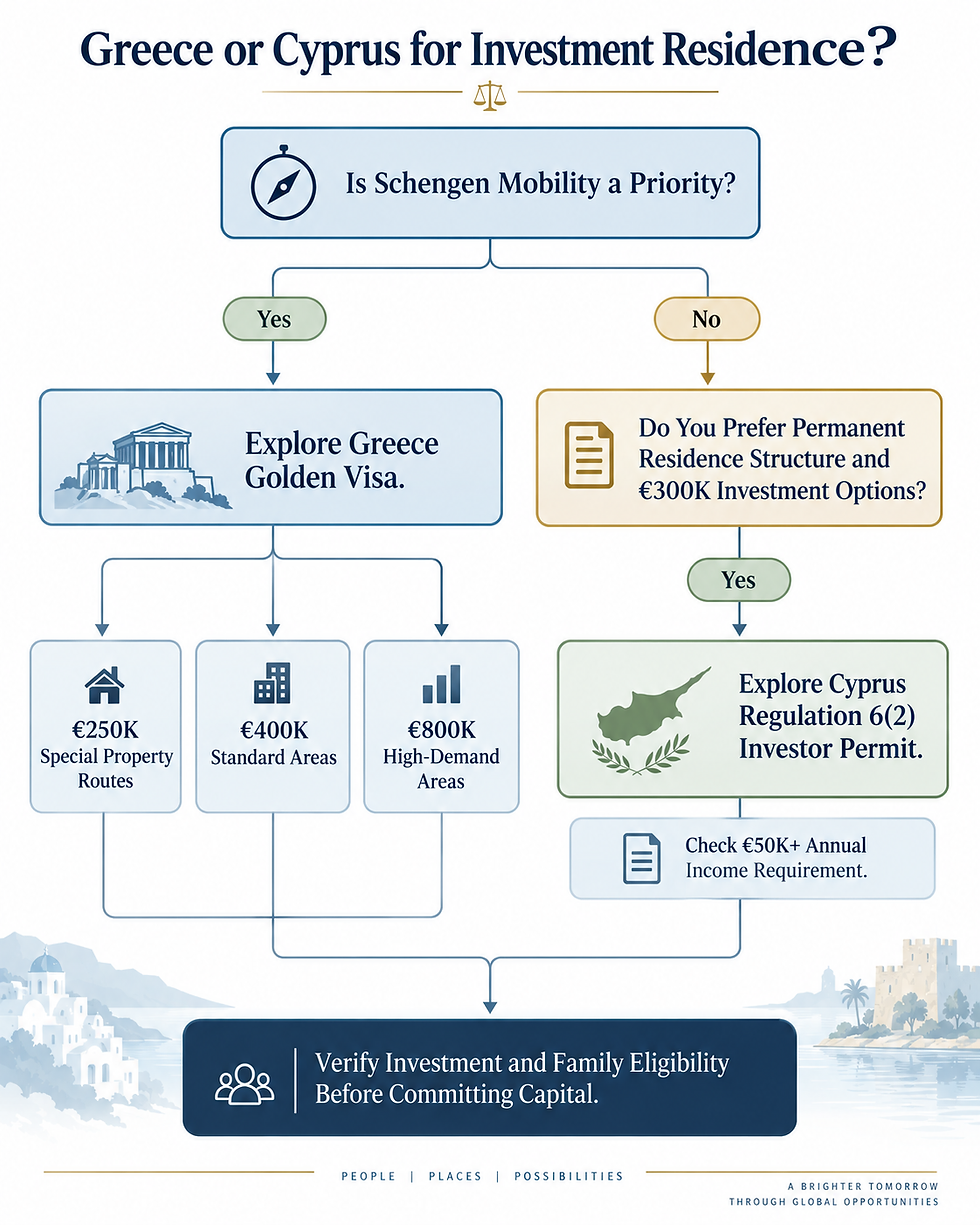
Cyprus Starts at €300,000 but Offers Several Investment Choices
Cyprus follows a different model.
Under Regulation 6(2), the applicant must generally invest at least €300,000 in one of several approved categories.
The Cyprus Migration Department currently recognises:
A new house or apartment
Other qualifying real estate, including certain commercial property
Share capital in an eligible Cyprus company
Units in qualifying Cyprus collective investment organisations
For a new house or apartment, the property must generally be a first sale from a development company with a value of at least €300,000 plus VAT where applicable.
The official Cyprus investor criteria also confirm that investments in eligible company share capital and qualifying investment funds can satisfy the same €300,000 threshold.
This can give Cyprus an advantage for investors who want a residence route without necessarily concentrating their capital in a conventional residential property.
Cyprus Also Requires Secure Annual Income
The minimum investment is only one part of the Cyprus financial test.
A principal applicant must also demonstrate secure annual income of at least €50,000.
The amount increases by:
€15,000 for a spouse
€10,000 for each dependent minor child
The Cyprus Migration Department confirms that this financial requirement applies in addition to the qualifying investment.
This creates a significant structural difference from Greece's property Golden Visa.
A comparison that says "Greece starts at €250,000 and Cyprus starts at €300,000" therefore leaves out important context. The actual decision depends on the Greek investment category, the Cyprus income requirement and the wider costs associated with each investment.
Greece Provides a Renewable Five-Year Residence Permit
A qualifying Greek Golden Visa investor generally receives a residence permit valid for five years.
The permit can be renewed for additional five-year periods where the qualifying conditions remain satisfied.
For investors who are already attracted to Greek property, this can create a long-term residence structure without requiring them to switch programmes at the end of each five-year period.
The broader greece investment visa framework should still be reviewed carefully because property eligibility, investment thresholds and residence rights are separate considerations.
Investors should also distinguish residence from citizenship. A Golden Visa is not an automatic route to a Greek passport simply because an investment has been maintained.

Cyprus Provides Permanent Residence Subject to Ongoing Conditions
The Cypriot investor route is structured differently.
The official Cyprus Migration Department states that the residence right granted through this Immigration Permit is of unlimited validity for the holder and adult dependants. The physical residence card generally has a ten-year expiry and must then be replaced.
That permanent-residence structure can be appealing to applicants who prefer not to hold a renewable five-year investor permit.
However, the investment cannot simply be forgotten after approval.
If the qualifying investment is disposed of without being immediately replaced by another qualifying investment of the same or greater value, the Immigration Permit can be cancelled.
Permanent residence therefore still comes with investment-maintenance and compliance responsibilities.
Schengen Mobility Is a Major Advantage for Greece
For internationally mobile investors, Schengen status can be more important than the difference between €250,000 and €300,000.
Greece participates fully in the Schengen Area.
Cyprus is a member of the European Union, but it had not yet fully implemented the Schengen acquis as of September 2026.
Current Cypriot government guidance states that visas and residence permits issued by Cyprus presently have validity for Cyprus and that broader Schengen movement rights will follow full integration.
The European Commission's 2026 State of Schengen Report also continued to identify completion of Cyprus's accession as an outstanding priority.
For someone seeking residence specifically because regular movement through the Schengen Area is important, Greece therefore has a clear present-day advantage.
Cyprus's position could change in the future, but investors should make decisions according to rights that currently exist rather than expected policy developments.
A New Cyprus Application Requirement From September 2026
There is also a recent procedural development worth noting.
For Immigration Permit applications in Categories A to F submitted from 1 September 2026, the Cyprus Migration Department requires specified medical documentation.
The official June 2026 announcement identifies blood-test documentation covering several specified conditions and a chest X-ray for tuberculosis screening, subject to its stated certification and exemption rules.
This does not change the €300,000 investment threshold, but it is another example of why applicants should work from current application requirements rather than older programme summaries.

How Family Needs Affect the Cyprus vs Greece Decision
Family structure can materially change the total residence strategy.
Cyprus's investor Immigration Permit can cover the applicant's spouse and children under 18.
Certain unmarried children aged 18 to 25 who remain financially dependent and are studying in tertiary education abroad can submit separate applications under specified conditions.
Cyprus also provides a mechanism for financially independent adult children, but it requires a higher investment.
The official policy gives the example that an investor relying on the same investment for one qualifying adult child would need €600,000, while two adult children would increase the investment to €900,000.
Families with older children should therefore compare the full cost of inclusion rather than focusing solely on the principal applicant.
Which Route Makes More Sense for Property Investors?
For a buyer primarily interested in property, Greece can offer greater variation.
The investor could potentially consider:
A qualifying €250,000 special property
A €400,000 standard property outside the higher-threshold zones
An €800,000 acquisition in a high-demand area
Cyprus offers a comparatively consistent €300,000 entry point for its qualifying property investment route, but the rules differ depending on whether the applicant purchases a new residence or another permitted type of real estate.
The residence permit should not replace normal investment analysis in either market.
Before buying, investors should review:
Legal title and ownership
Property classification
Market value
Location
Rental demand
Resale prospects
Renovation requirements
Taxes and transaction costs
Restrictions connected to the residence programme
Long-term maintenance expenses
A property can meet immigration criteria and still be a poor investment. Residence eligibility and investment quality should be tested separately.
When Greece May Be the Stronger Choice
Greece may suit investors who:
Consider Schengen mobility a major priority
Already want to own Greek property
Prefer a five-year renewable residence structure
Can identify an appropriate €250,000, €400,000 or €800,000 qualifying route
Want their European residence and property investment strategies centred on Greece
The ability to choose between several property thresholds can be useful, particularly for investors willing to consider specialised opportunities rather than only standard residential acquisitions.
When Cyprus May Have the Advantage
Cyprus may suit investors who:
Prefer a permanent-residence structure
Can invest at least €300,000
Can satisfy the secure annual-income requirement
Want alternatives to residential real estate
Do not currently require residence issued by a fully participating Schengen country
For these applicants, Cyprus should be viewed as a different residence strategy rather than simply a cheaper or more expensive version of Greece.
Cyprus vs Greece Golden Visa: Which Should You Choose?
The right choice depends on what the investor expects the residence programme to achieve.
For Schengen mobility, Greece currently has the advantage.
For a permanent-residence structure, Cyprus may be more attractive.
For investors specifically targeting Greek property, Greece offers more relevant real-estate options but also a more complex threshold system.
For investment-format flexibility, Cyprus offers qualifying routes involving property, company capital and investment funds.
The best comparison therefore combines four questions:
What type of residence does the family need?
How important is Schengen mobility?
What type of investment makes financial sense?
Which family members need residence rights?
Once those questions are answered, the difference between the two routes becomes much clearer.
Frequently Asked Questions
Is Cyprus or Greece cheaper for residency by investment?
Neither is always cheaper. Cyprus generally requires at least €300,000, while Greece offers certain special property routes from €250,000. Standard Greek property investments generally require €400,000 or €800,000 depending on location.
Is the Cyprus investor route actually a Golden Visa?
"Cyprus Golden Visa" is widely used as a commercial description. The official expedited route is an Immigration Permit under Regulation 6(2), structured as permanent residence.
Does Cyprus require €50,000 annual income?
Yes. The main applicant generally needs secure annual income of at least €50,000. Additional amounts apply for a spouse and dependent minor children.
Can I still get the Greece Golden Visa with €250,000?
Yes, but only through specific qualifying categories. The €250,000 amount is not a general minimum for all property purchases in Greece.
Is Cyprus in the Schengen Area in 2026?
As of September 2026, Cyprus had not yet fully integrated into the Schengen Area. Current Cypriot government information still distinguishes Cyprus-issued residence permits from those issued by fully participating Schengen countries.
Does the Cyprus investment permit expire?
The residence right for the main holder and adult dependants is described by the Cyprus Migration Department as having unlimited validity, subject to the programme's conditions. The physical residence card generally needs replacement after ten years.
Which option is better for European mobility?
Greece currently has the stronger position for investors prioritising Schengen mobility because Greece already participates fully in the Schengen Area.
Final Thoughts
The Cyprus vs Greece Golden Visa comparison is ultimately a choice between two different approaches to investment-linked European residence.
Greece combines a renewable five-year investor permit with current Schengen membership and property investment levels ranging from €250,000 for special categories to €800,000 in higher-demand locations.
Cyprus combines a €300,000 minimum qualifying investment with a permanent-residence structure, several potential investment formats and a separate secure annual-income requirement.
Neither route should be selected solely because of its headline investment figure. Investors should consider the quality of the underlying investment, residence rights, mobility, family eligibility and continuing compliance obligations together.
For investors who also want to compare Greece and Cyprus with wider international residency and citizenship solutions, Level Immigration provides guidance across multiple investment migration programmes.



Comments