Greece Golden Visa for Family Wealth Planning and Backup Residency

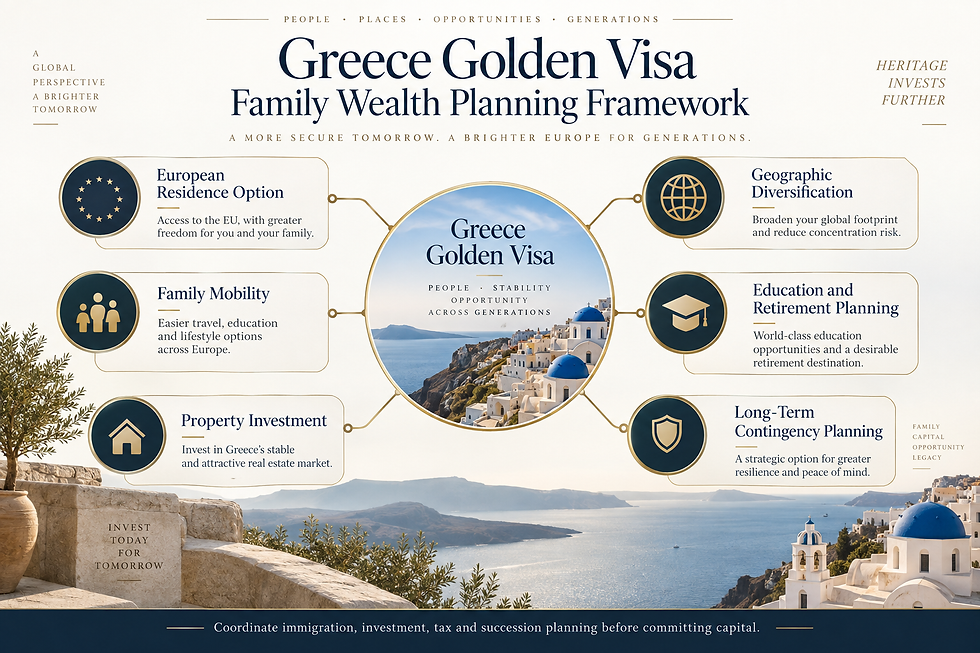
The Greece Golden Visa for family wealth planning can serve a purpose that goes beyond acquiring property or obtaining a European residence permit. For internationally mobile families, it can form part of a broader strategy for maintaining residency options, diversifying assets and creating a practical European base that may be available if family circumstances, business priorities or long-term plans change.
That does not make the Golden Visa a substitute for tax, succession or estate planning. Instead, it can complement those strategies by adding another element: a legally recognised residence position in Greece linked to a qualifying investment.
For families thinking several years ahead rather than planning an immediate relocation, that distinction is important.
Why Families Use the Greece Golden Visa for Wealth Planning
High-net-worth families often hold assets, businesses and family connections across more than one jurisdiction. Their planning therefore tends to involve more than investment returns alone.
Residence flexibility can become relevant when considering:
future relocation options;
children's education;
access to a European family base;
property diversification;
retirement planning;
succession and inheritance preparation;
geopolitical or economic uncertainty;
changing business interests; and
lifestyle planning across generations.
A Greek residence permit can add another layer of optionality to that structure.
Official Greek guidance confirms that qualifying investor residence permits are generally issued with five-year validity, subject to the relevant investment and renewal conditions. Family members can also qualify for linked residence rights under the applicable rules. Greek investor and family residence permit requirements
Investors considering the broader structure can review the available Greece Golden Visa programme before deciding which investment route best fits their family's objectives.
What Does “Backup Residency” Actually Mean?
Backup residency is best understood as residence optionality, not as an emergency passport.
A family may continue living primarily in another country while maintaining a lawful residence position elsewhere, provided the requirements of the relevant programme continue to be satisfied.
That can be useful when a family does not want to relocate today but wants to avoid starting the residency process from zero if circumstances change later.
Possible scenarios include a future decision to:
spend more time in Europe;
place children in European schools or universities;
retire or semi-retire in Greece;
establish a second family home;
diversify away from one primary country of residence; or
create a more flexible international lifestyle.
A Greek residence permit also provides a basis for short visits to other Schengen countries under the applicable Schengen rules. The European Commission explains that holders of a residence permit issued by a Schengen country may generally travel to another Schengen country for up to 90 days in a 180-day period, subject to entry requirements. European Commission guidance on travel with a residence permit
That mobility can make a Greek residence position particularly relevant for internationally active families, although it should not be confused with unrestricted residence rights throughout the EU.
Family Inclusion Makes the Strategy More Useful
For wealth planning, a residence solution is considerably more useful when it is structured around the family rather than only the principal investor.
Greek administrative guidance identifies qualifying family categories for permanent investors that can include a spouse or eligible partner, children and direct ascendants under the relevant conditions. The precise treatment of children can depend on age and the applicable permit category, so family eligibility should be reviewed individually before an investment is completed.
This can help families build a coordinated residence structure instead of requiring every family member to establish a separate investment.
It may also be relevant for families considering multigenerational planning. Parents, younger family members and the principal investor may have very different reasons for wanting European residence, ranging from retirement and healthcare planning to university access or future business expansion.
The important step is to map the family structure before purchasing an investment.
Property Can Serve Both Residency and Asset-Planning Goals
Real estate remains closely associated with Greece's investor residence framework, but families should separate two questions:
Does the property satisfy the applicable Golden Visa requirements?
Does the property make sense as part of the family's wider portfolio?
A property can satisfy programme rules and still be a poor investment for a particular family because of location, liquidity, renovation requirements, rental restrictions, holding costs or exit strategy.
Likewise, an attractive property investment is not automatically Golden Visa eligible.
Investors comparing available opportunities should therefore assess Greece Golden Visa properties only after defining their residency objective, budget, ownership structure and expected investment horizon.
For family wealth planning, due diligence should extend beyond the purchase price. Title, planning compliance, property condition, Golden Visa eligibility, transaction structure and the family's intended holding period can all affect the usefulness of the investment.
Treat the Residence Permit and Tax Residence Separately
One of the most important distinctions in cross-border planning is the difference between immigration residence and tax residence.
Holding a Greek residence permit does not mean every family should automatically structure its affairs as though it were tax resident in Greece. Greek tax residence follows its own statutory criteria.
The Greek Independent Authority for Public Revenue states that tax residence can depend on factors including a person's permanent or principal residence, habitual abode, centre of vital interests and, subject to statutory exceptions, presence in Greece exceeding 183 days during a twelve-month period. Greek tax-residence rules for individuals
This is why family wealth planning should normally involve separate reviews of:
immigration status;
personal tax residence;
investment ownership;
inheritance and succession rules;
company ownership;
source of funds;
property taxation; and
double-taxation treaty considerations.
The residence permit is one component of that structure, not the structure itself.
Building a Long-Term Family Residency Strategy
A well-planned Golden Visa strategy should start with the family's objective rather than the investment.
For example, a family whose primary goal is contingency residence may prioritise simplicity, long-term eligibility and manageable ownership obligations.
A family focused on wealth diversification may place greater emphasis on asset quality, location, rental potential and eventual resale.
A family preparing for future relocation may need to consider schooling, healthcare, neighbourhood selection and tax exposure much earlier.
A useful planning sequence is:
Define why the family wants a second residence option.
Identify which family members need residence permits.
Review current and potential future tax residence.
Establish the investment budget.
Compare qualifying Golden Visa routes.
Conduct legal and technical due diligence.
Review source-of-funds documentation.
Complete the qualifying investment.
Submit the residence applications.
Create a renewal and long-term asset-management plan.
Review succession implications.
Establish an eventual exit strategy.
This approach turns the Golden Visa from a single transaction into part of a wider family plan.

Think About the Exit Before Making the Investment
Families often concentrate on obtaining the permit and give less attention to what happens five, ten or fifteen years later.
A stronger wealth-planning approach considers the exit at the beginning.
Questions should include:
How long does the family expect to hold the asset?
Who will manage it?
Will the property be used personally or primarily as an investment?
What happens if family members relocate permanently?
How will ownership fit into the family's estate plan?
Could a future sale affect the residence strategy?
What costs are likely to continue throughout ownership?
These questions matter because the value of backup residency depends partly on whether the family can maintain the qualifying structure comfortably over time.
The cheapest route at acquisition is therefore not necessarily the most suitable route over a decade.
Golden Visa Residency Is Not the Same as Citizenship
Families should also distinguish residence planning from citizenship planning.
A Golden Visa provides residence rights under Greek immigration law. It should not be described as automatic Greek citizenship or a guaranteed EU passport pathway.
Citizenship involves separate statutory requirements and should be evaluated independently if it forms part of the family's long-term objectives.
For many investors, citizenship may not even be the immediate goal. The value of the structure may instead lie in maintaining a renewable European residence position while preserving flexibility over where the family actually lives.
Frequently Asked Questions
Is the Greece Golden Visa suitable for backup residency?
It can be suitable for families seeking an additional European residence option while maintaining their main life elsewhere, provided they continue to satisfy the programme's investment and renewal requirements.
Can family members be included?
Qualifying family members can receive residence rights under the investor framework. Eligibility depends on the relationship, age and applicable legal requirements, so the complete family structure should be checked before applying.
Does a Greek Golden Visa automatically make me a Greek tax resident?
No automatic conclusion should be made. Greek tax residence is determined under separate tax rules, including residence, habitual abode, centre of vital interests and physical-presence criteria. Tax advice should therefore be obtained separately from immigration advice.
Can the Golden Visa be part of family wealth planning?
Yes. It can be incorporated into a wider strategy involving property ownership, geographic diversification, succession planning and future residence flexibility. However, those areas should be coordinated with appropriate legal and tax advice.
Does a Greece Golden Visa provide EU citizenship?
No. It is a Greek residence permit. Citizenship is a separate legal process with its own requirements.
Should a family choose the lowest-cost qualifying investment?
Not necessarily. Investment suitability, legal eligibility, location, property quality, ongoing costs, liquidity and exit strategy can be more important than choosing an investment solely because it meets a minimum threshold.

Conclusion
For internationally mobile families, the Greece Golden Visa can be viewed as more than a residence-by-investment transaction. Properly structured, it can create a European residence option while supporting broader goals involving family mobility, property ownership and long-term geographic diversification.
The strongest strategy begins by defining the family's objective, identifying who needs residence rights, reviewing tax and succession considerations and only then selecting the investment.
That order matters. A property should support the family strategy rather than forcing the family strategy to fit the property.
For families comparing Greece with other international residence and citizenship structures, Level Immigration provides information on residency and citizenship programmes across multiple jurisdictions.


Comments